









Myth 01 / 10
“Wolf hunting is management.”
A team of wildlife advocates, outdoor people, educators and scientists. We say the quiet part out loud... and then we raise howl.
The latest wolf populations, who sets the rules, and the story in each state.
At least6,600
The history, the science and the myths about wolves, in plain language.
 teamwolf.kids · ages 8 to 12 ↗
Read
Peter and the Wolves ↗Chief Scientist Dr. Peter Kareiva on Substack
Scripts, guides, social posts and the one-pager to hand a rancher. Ready to use.
Congress is deciding whether wolves keep federal protections. Your letter takes two minutes.
Take actionThe history, the science, and the myths that still shape the debate.
Science tells us why wolves matter: they're intelligent, family-oriented animals and a keystone species that keeps whole ecosystems in balance. Here you'll find the recent history of wolf protections, the research behind the debate, and the myths that mask the cruelty of the hunts.
We’ve illustrated the real facts behind wolves on our landscape, the relationship between wolves and cattle, and the fight to protect wolves—one chart at a time.
See the infographics →Cattle: USDA NASS, Jan. 1, 2026 · Gray Wolves: estimated, ten states
From near extinction to the 90-day clock running now.
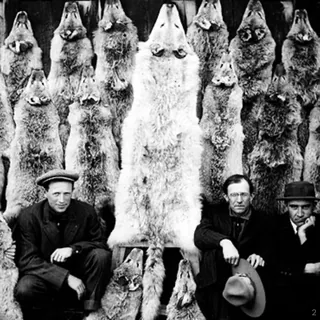 1926
Bounties, traps and poison wiped wolves out of nearly all of the lower 48, much of it paid for by the government. In 1926, park rangers killed the last wolf pack in Yellowstone. Only a sliver of northern Minnesota still had wolves.
Gray Wolves were among the first animals protected under the new Endangered Species Act, which made killing them a federal crime.
The Fish and Wildlife Service set the Northern Rockies goal at 10 breeding pairs in each of three recovery areas. It was revised once, in 1994, to about 300 wolves across Idaho, Montana and Wyoming. The target has not been updated since.
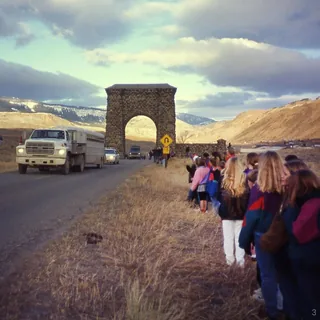 1995
Wolves from Alberta and British Columbia were released in Yellowstone and central Idaho in 1995 and 1996. The Northern Rockies population grew from there.
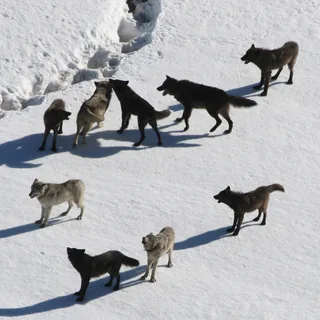 2011
A budget rider removed federal protections from wolves in Idaho, Montana and parts of neighboring states. No scientific review came first.
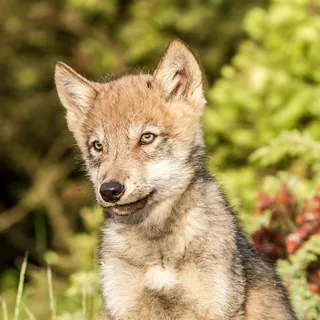 Late 2020
The federal government took Gray Wolves off the endangered species list, against the advice of scientists. This emboldened states in the Northern Rockies (where wolves were already under state authority) to pass laws and policies aimed at killing up to 90% of the region's wolves.
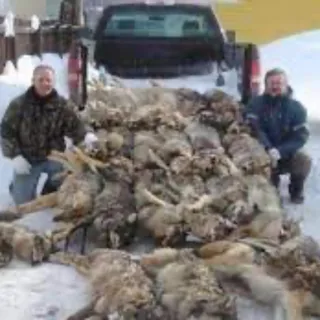 Feb 2021
A court-ordered hunt in Wisconsin killed 218 wolves, nearly double the state hunters’ share of 119. Team Wolf was founded in response, and every Team Wolf stamp memorializes that hunt.
Government lawyers asked a federal judge to uphold the 2020 rule that stripped wolves’ federal protections.
 Sept 2021
The Fish and Wildlife Service found that new laws in Idaho and Montana may threaten wolves, and opened a year-long review. The hunts kept going while it looked.
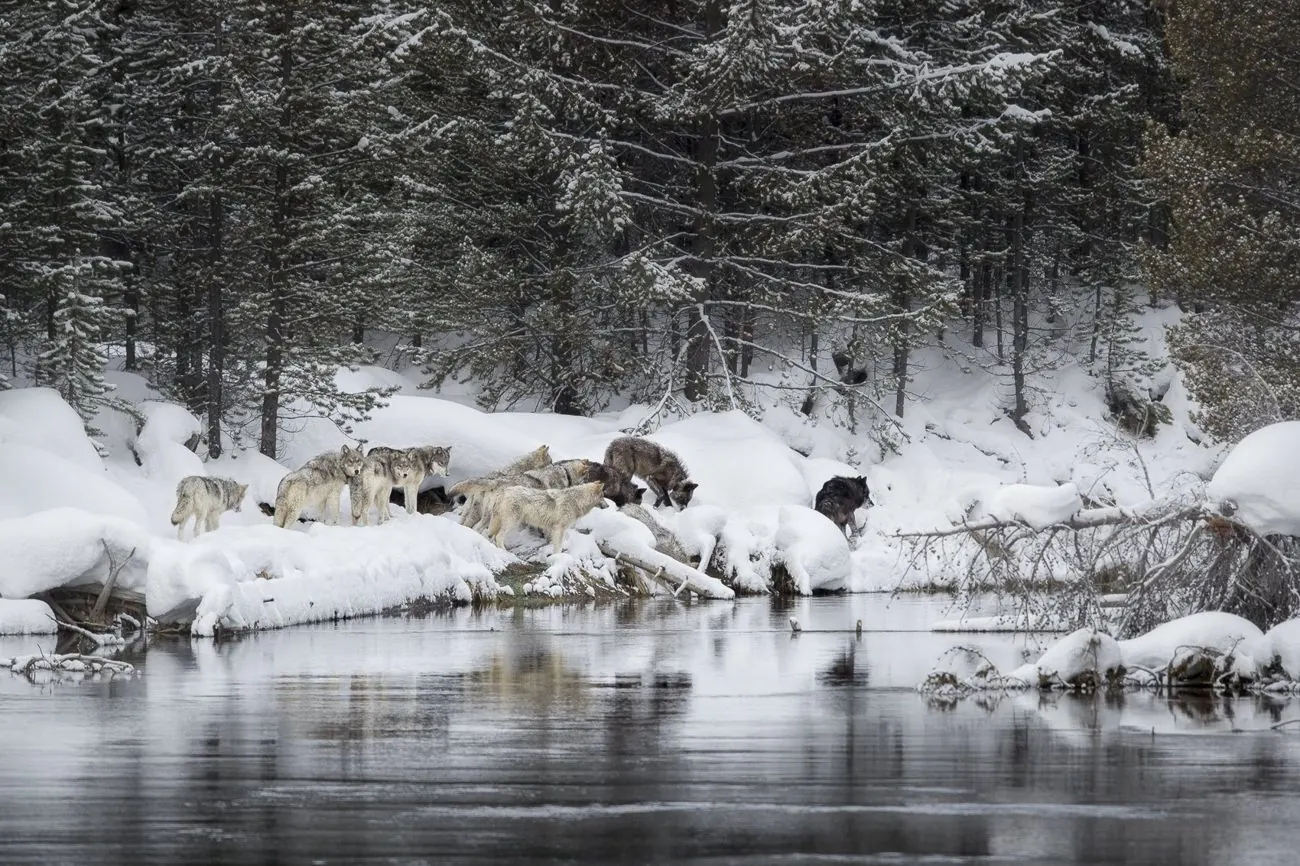
Hunters killed 25 of Yellowstone's wolves at the park boundary. Yellowstone's wolf project is still one of the world's most compelling examples of ecological recovery, and it is being unwound at the invisible border.
 Feb 10, 2022
A federal court restored protection to wolves across most of the lower 48. The Northern Rockies, where most of the killing happens, stayed out.
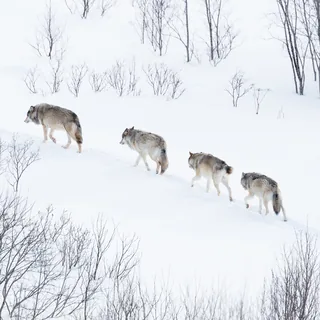
Montana had removed the limit on how many wolves can be killed near Yellowstone in 2021. The public and the Park Service pushed its commission to restore one.
 Jan 2023
The appeals of the 2022 ruling were put on hold until February 2024 while the Fish and Wildlife Service redid its status review.
 Feb 2024
The Fish and Wildlife Service declined to put wolves back on the list, and promised the first national recovery plan for Gray Wolves by December 2025.
 Sept 2024
The Biden administration asked the Ninth Circuit to overturn the 2022 ruling and remove wolves’ federal protections across most of the lower 48.
A federal court vacated the Fish and Wildlife Service's 2024 finding that relisting was not warranted, and ordered the Service to redo its assessment.
The Fish and Wildlife Service formally concluded it would not write a national recovery plan at all, finding that one “would not promote the conservation” of Gray Wolves because listing “is no longer appropriate.”
 Dec 18, 2025
The House passed H.R. 845—a bill that would delist wolves—by seven votes. It now sits in the Senate Environment and Public Works Committee, where it needs 60 votes it does not have.
Section 128 was stripped from a funding bill before it became law, with Team Wolf’s help. Lawmakers added it back as Section 125.
The Center for Biological Diversity sued in federal court to compel the Service to produce a recovery plan. That case is pending.
Public pressure, led by Team Wolf, got H.R. 1897 pulled from the House floor. It can still come back.
The 2027 Interior funding bill arrived carrying Section 125: a permanent nationwide delisting, with the courts barred from reviewing it.
 Sept 4, 2026
An executive order gave the Interior Department 90 days to decide whether Gray Wolves keep federal protection. A decision is expected around December 3.
Send the letter to Congress →H.R. 845 passed by seven votes. In January, at least 31 of the people who voted for it will be gone.
Idaho, Montana and Wyoming still encourage hunters to kill up to 90% of the region's wolves, often without knowing how many wolves they actually have, and usually on the pretext of livestock losses—despite wolves accounting for less than 1% of unwanted livestock deaths, and despite research finding nonlethal methods more than 2.5× as effective at reducing conflict.
Recovery decisions should be transparent, grounded in the best available science, and accountable to the public. Until they are, thousands of wolves will continue to be killed each year under plans built on data the states themselves have admitted was wrong.
What you have heard, and what the evidence says.
For centuries wolves have been cast as villains—Little Red Riding Hood, the Big Bad Wolf, and every fable since. Science gives us a chance to see them as they actually are, and the real story is more interesting. Here are the myths worth retiring.
0 of 10 busted
“Wolf hunting is management.”
“Hunt limits are set by science.”
“Hunts can be controlled.”
“The population has bounced back, so protection isn’t needed.”
“Wolves are a threat to the livestock industry.”
“Wolves are the villain.”
“Wolves from Canada are a bigger, meaner superwolf.”
“Wolves are killing off the elk.”
“The 2022 ruling protected all wolves.”
“Tribes were consulted before wolves were delisted.”
Wolves are one of the few species we can truly recover in our lifetimes. Here is the research behind every position we take, with its supporting sources.
Science is only as strong as the data behind it. Every position we take is built on peer-reviewed research—and we hold agencies to the same standard we hold ourselves. Facts first.
Wolves won't be under federal protection forever. That should be a good thing, but today states have not proven they can be responsible stewards of wolves. When states do have authority over wolves, the standard of best available science should be the same.

“Wolves deserve our best science, not vilification.”
Every study behind our positions, with what it found and a link to the source. Pick a topic.
Treves et al. · Conservation Science and Practice
A review of the five best-designed studies, from five countries, found that killing wolves usually made no difference to how many livestock and dogs were lost.
Jacobs, Kareiva and Schachtschneider · Rangelands
Nonlethal tools cut conflict between wolves and livestock by 91%. Killing wolves cut it by 39%.
vonHoldt et al. · Molecular Ecology
Gray Wolves are numerous enough to avoid inbreeding problems in the short term, but below the size needed to avoid a long-term risk of extinction. Northern Rockies wolves carry less genetic diversity than Great Lakes wolves, and it has been falling.
Ripple et al. · BioScience
With wolves gone from western national parks, elk overbrowsed young trees for decades. Most of the region's ecology research was done after the wolves had already disappeared.
Crabtree et al. · Preprint, Yellowstone Ecological Research Center
Montana's counting model, iPOM, could overstate the number of wolves by as much as 2.5 times.
Released before peer review, and disputed by Montana FWP at the time. Montana has since revised the model, which now puts the state at about 725 wolves.
Treves and Santiago-Ávila · Academia Biology
Wisconsin's newer counting method would overestimate how many wolves the state has, by margins no one can yet calculate.
Cassidy et al. · Frontiers in Ecology and the Environment
When people kill one member of a pack, the chance the pack stays together that year drops 27% and the chance it breeds the next year drops 22%. Lose a pack leader and those fall 73% and 49%.
Oliynyk · Scientific Reports
In Minnesota, the yearly death rate for collared wolves doubled, from 21.7% to 43.4%, once hunting began in 2012, and deaths caused by people stayed high for five years after the hunt was stopped.
Elbroch and Treves · Biological Conservation
Killing carnivores can leave younger, less experienced animals and broken social groups behind, which can raise the risk to livestock instead of lowering it.
National Caucus of Environmental Legislators · Report
State endangered species laws need regular updates, real habitat protection and incentives for landowners.
Kareiva, Attwood et al. · Conservation Science and Practice
The states hunting wolves hardest publish little usable data on wolf kills, livestock losses or the other animals caught in wolf traps.
Anderson et al. · The Canadian Geographer
Washington's approach to living with wolves depends on keeping wolves afraid of people. Biologists and ranchers mean different things by that fear, and the gap feeds the conflict.
Ripple et al. · BioScience
Proposes bringing back Gray Wolves and beavers across federal land in the West, through a network of rewilding areas.
Humane Society of the United States · Report
By the USDA's own numbers, wolves took 0.009% of the U.S. cattle inventory, and domestic dogs killed twice as many cattle as wolves did.
USDA APHIS · Government report
Almost 98% of adult cattle deaths came from causes other than predators: disease, weather, calving problems, old age.
Stone et al. · Journal of Mammalogy
Over seven years, sheep losses to wolves were 3.5 times higher outside the area protected with nonlethal tools. No wolves were killed inside it.
The questions people ask us most, answered with the numbers and the sources.
Idaho ran the experiment. From 2015 to 2022, the number of wolves killed each year rose 65%. Livestock losses rose 64% right alongside it, from 170 a year to 279.
A public hunt doesn’t find the wolf that killed a calf. It takes whichever wolves hunters can find, often the breeding adults that hold a pack together. Across Idaho, Montana, Oregon and Washington from 2005 to 2021, each wolf killed by hunters prevented about 0.05 livestock deaths: roughly 14 dead wolves for one cow.
Sources Idaho Fish and Game wolf plan, Table 1 · Merz et al. (2025) · Bradley et al. (2015)
A wolf pack is a family. When people kill one of the parents, the odds that family is still together at the end of the year drop by 73%.
The breeding pair are the parents. The rest are their grown offspring, and they do real work: bringing down a bison takes 9 to 13 wolves. Across 193 packs in five national parks over 35 years, packs that lost no wolves to people stayed together 92% of the time. Packs that lost even one wolf to people: 76%. Killing one wolf doesn’t subtract one wolf. It subtracts what that wolf did for the rest.
Sources Cassidy et al. (2023) · Brainerd et al. (2008) · MacNulty et al. (2014)
No. Conservation keeps a population healthy for the long run. Public wolf hunts are recreation, and in the Northern Rockies the federal government’s own scientists found that hunting and agency killing, not the land, now decide how many wolves there are.
States call their hunts “management.” Look at what one looks like: in Wisconsin’s February 2021 hunt, state-licensed hunters killed 218 wolves in under three days, 86% of them with packs of hounds, and blew past their share of 119. A hunt doesn’t target the wolves in a conflict, and it doesn’t make a population healthier. There is no scientific, ecological or ethical case for killing wolves for sport.
Sources Gray wolf species status assessment, western U.S., 2023 (USFWS) · Gilbert et al. (2022) · Wisconsin Legislative Council, 2021 wolf hunt
With a toolbox that works better than killing wolves. A 2025 peer-reviewed review found nonlethal methods cut the risk of wolf–cattle conflict by 91% on average. Killing wolves cut it by 39%.
Nonlethal isn’t one gadget. It’s a toolbox: range riders, fladry (lines of flagged fencing), electric fencing, guardian dogs, picking up carcasses, penning stock at night, shifting calving and grazing times, lights and noise devices. In Montana’s Blackfoot Valley, ranchers, agencies and neighbors have used these tools together for years. When someone says nonlethal doesn’t work, ask which tool they tried, how it was paid for, and who kept it up. An unfunded tool nobody tends isn’t a test of the method.
Sources Jacobs, Kareiva & Schachtschneider (2025), Rangelands · Wilson, Bradley & Neudecker (2017), Blackfoot Valley · Wolves & Cattle: The Numbers
Legally, yes, in most of the country, for now. Scientifically, the question is whether wolves here can last, and they aren’t there yet.
The law. “Endangered” is a legal status under the Endangered Species Act.
The science. The question is whether wolves can last here. In the lower 48 they’ve been wiped out of roughly 90% of the land they used to live on. Genetic work published in 2024 found America’s wolves above the size needed to avoid inbreeding damage now, and below the size needed to survive the long run. A headcount tells you how many wolves there are, not whether they’ll still be here.
Sources Reinstatement of gray wolf protections, 2023 (Federal Register) · Gray Wolf range in the contiguous U.S. (USFWS) · vonHoldt et al. (2024) · Mexican Wolf program, 2024 annual report (USFWS) · Red Wolf (USFWS) · Wolves by State
Not yet, but it’s possible soon. A September 4 executive order gave the Interior Secretary 90 days, to about December 3, to decide whether Gray Wolves and Mexican Wolves should lose protection. The order itself changes no wolf’s status.
Taking a species off the list takes a formal rule with a public comment period, and that rule can be challenged in court. Federal courts have overturned five attempts to strip wolf protections. The order also asks Congress to delist both, pushes states to loosen their own rules, and tells agencies to accept weaker evidence for livestock-loss claims. Congress can protect wolves through law, whatever Interior decides. Send the letter to Congress →
Sources Executive Order 14425, “Supporting America’s Ranchers” (Federal Register) · Gray Wolf delisting clock runs toward Dec. 3 (International Wolf Center) · Five tries, five losses in court
Yes, and they are. Across five national parks over 35 years, people caused 36% of all deaths among radio-collared wolves.
At Voyageurs, poaching was the single most common cause of death. Only about 7% of those wolves died inside a park. The law also already allows killing protected wolves in defined cases, including some responses to confirmed livestock losses. So protection was never a guarantee. The real questions are who decides when a wolf dies, on what evidence, and why illegal killing goes uncounted.
Sources Cassidy et al. (2023) · Colorado experimental population rule (USFWS) · USDA Wildlife Services
Not as well as the headline numbers suggest. No two states count wolves the same way, at the same time of year, by the same method, so the numbers can’t honestly be added up. Most of the methods have never been through peer review.
Idaho uses genetics in summer, after pups are born, when the count is highest. Minnesota counts in winter, before pups, when it’s lowest. Montana published two estimates for the same year, 1,094 wolves under its old model and 725 under the new one, a difference of 369 wolves. Team Wolf’s Report Card grades ten states on how they count, against their own published documents.
Sources State Wolf Report Card · Montana FWP, 2025 wolf report · Idaho Fish and Game, counting method · Minnesota DNR, survey method
There is no modern record of a wild wolf killing a person in the lower 48.
A worldwide review of 2002 to 2020 found two fatal wolf attacks in all of North America in those 18 years: Saskatchewan in 2005 and Alaska in 2010. Neither was in the lower 48. Wild wolves avoid people. The gap between the fear and the record is enormous.
Sources Linnell et al. (2021)
Sometimes, and the record points at hunting dogs. Every attack in Wisconsin DNR’s current table of wolf attacks on dogs involves hunting hounds running loose in wolf country.
Most of them come from July through September, when wolves guard pups at rendezvous sites, and the DNR’s advice is to move two or three miles from a known site before releasing dogs. Livestock guardian dogs are different. They’re bred and placed to stand between predators and a herd, so when one faces down a wolf, it’s doing its job. Colorado State University Extension says guardian dogs can deter wolves, and that the right breed and number of dogs matters.
Sources Wisconsin DNR, wolf attacks on dogs · Colorado State University Extension, Wolves and Livestock
Yes. Every dog alive descends from wolves.
Dogs were tamed from Gray Wolves during the last Ice Age. A 2022 study of ancient wolf DNA, published in Nature, found today’s dogs carry ancestry from at least two separate ancient wolf populations. So when someone calls the wolf a villain, they’re talking about your dog’s family.
Sources Bergström et al. (2022), Nature